Global Markets on Edge: Geopolitical Tensions, AI Investments, and Corporate Earnings Reshape Investor Strategies


Lead: Global markets brace for volatility as geopolitical flashpoints, AI-driven corporate pivots, and earnings surprises redefine investment playbooks.
From the Strait of Hormuz to Silicon Valley, today’s coverage reveals how governments and corporations are recalibrating strategies in response to escalating tensions and technological disruption. Investors are navigating a landscape where traditional economic levers are being reshaped by AI infrastructure spending, semiconductor demand, and shifting trade routes.
This comprehensive roundup examines the forces driving today’s market movements, with exclusive insights from panel discussions, field reports, and breaking updates across politics, business, and technology sectors.
ameritrade's Best Political Coverage: Escalation and De-escalation in the Persian Gulf
U.S.-Iran tensions dominate geopolitical headlines as the Biden administration’s strategic calculus faces its sternest test yet. The overnight announcement of a distant blockade targeting Iranian vessels in the Strait of Hormuz has sent shockwaves through global shipping lanes, with analysts warning of potential disruptions to 4.5 million barrels of oil per day.
[CLIP: U.S. Announces Distant Blockade Against Iranian Ships - 0:10]
The U.S. Navy’s announcement that ships transiting the Strait of Hormuz would be turned away marks a significant escalation in Washington’s economic warfare strategy. Speaking from the Naval War College, maritime security expert Sal Mercogliano emphasized the legal complexities under UNCLOS, noting that ‘this is not a traditional blockade but a strategic move to pressure Iran’s oil exports without triggering a full-scale conflict.’
Iran-U.S. ceasefire holds, but markets remain jittery
The fragile ceasefire, brokered under intense diplomatic pressure from G7 allies, has so far prevented a broader regional conflict. However, the extension of the truce by President Trump has done little to calm investor nerves. Wall Street’s reaction was immediate: the S&P 500 slipped 0.8% in early trading, while crude oil futures surged 3.2% on fears of supply chain disruptions.
[CLIP: Live Market Reaction to Geopolitical Developments - 3:22]
In a live market update from the New York Stock Exchange, Schwab Network’s panel dissected the ceasefire’s impact on sector performance. ‘The market is pricing in a 60% probability of renewed tensions within 90 days,’ noted one analyst. ‘The ceasefire buys time, but the underlying geopolitical fractures remain.’
Congress returns, but War Powers Act looms large
The U.S. Congress reconvenes this week with a full agenda, but the overriding question is whether lawmakers will assert their constitutional authority over military engagements. The War Powers Act, dormant since the 2003 Iraq War, is suddenly back in play as progressive Democrats and libertarian Republicans demand a vote on any further strikes against Iran.
[CLIP: Congress and Military Authorization: Legal and Political Implications - 0:06]
‘This is a constitutional crisis waiting to happen,’ warned constitutional law expert Joe Mazzola. ‘If Congress fails to act, it sets a dangerous precedent where the executive branch can wage war without legislative oversight.’ The political fallout could extend beyond Iran, reshaping the 2026 midterm elections.
Trade realignments and economic coercion
Keir Starmer, the UK’s opposition leader, framed the current crisis as a ‘tectonic shift in global trade.’ In an exclusive interview with ameritrade, Starmer outlined how the conflict is accelerating the formation of alternative shipping routes, including a proposed corridor from Saudi Arabia’s Yanbu port to the U.S. West Coast. ‘This is not just about oil; it’s about who controls the arteries of the global economy,’ he stated.
[CLIP: Geopolitical Trade Realignments and Economic Coercion - 1:55]
The economic coercion strategies employed by both the U.S. and Iran are also reshaping alliances. China and Russia are quietly exploring mechanisms to bypass Western sanctions, while Japan and South Korea are hedging their bets by increasing strategic oil reserves. The ripple effects are being felt in commodity markets, with copper and aluminum prices surging on supply chain concerns.
Press Monitor Clips:
U.S. Announces Distant Blockade Against Iranian Ships;
Live Market Reaction to Geopolitical Developments;
Congress and Military Authorization: Legal and Political Implications
ameritrade's Best Business Coverage: AI Spending Surge and Earnings Whiplash
Tesla’s AI pivot steals the earnings spotlight
Tesla’s latest earnings report has sent shockwaves through the AI and automotive sectors, with the company’s stock surging 17% on the back of its ‘AI-first’ strategy. Olivia Blanchard, lead analyst at Futurum, described the report as ‘a masterclass in pivoting from automaker to AI infrastructure company.’
[CLIP: Tesla Earnings Deep Dive: AI Transition and Market Reaction - 4:05]
The numbers tell a compelling story: Tesla beat earnings estimates by 12%, but the real headline was its $25 billion capital expenditure plan focused on robo-taxis and humanoid robots. ‘Investors are rewarding Tesla not for its cars, but for its bet on physical AI,’ noted Blanchard. The stock’s rally has lifted the entire AI ecosystem, with NVIDIA and AMD both posting gains despite broader market headwinds.
Intel’s 200% rally defies semiconductor gravity
Intel’s post-earnings surge—up 200% from its 2025 lows—has left analysts scrambling to explain the rally. Joe Mazzola, Ameritrade’s senior market strategist, attributed the move to ‘a perfect storm of AI demand, supply chain tightness, and short covering.’
[CLIP: Intel Stock Performance and Market Implications - 2:28]
The chip giant’s earnings beat was modest, but its guidance for server CPU demand in AI data centers sent shockwaves through the semiconductor space. ‘Intel is no longer playing catch-up to NVIDIA; it’s leapfrogging the competition with its integrated AI solutions,’ said Frank Lee, RBC’s semiconductor analyst. The rally has also spilled over into related sectors, with ServiceNow and Palantir both posting double-digit gains.
Bitcoin’s $80,000 flirtation and institutional adoption
Bitcoin’s recent rally to $80,000 has reignited debates about its role as a macro asset. Sam Callahan, lead analyst at Orange BTC, argued that ‘Bitcoin is now being priced as a hedge against geopolitical risk, not just a speculative asset.’
[CLIP: Bitcoin and Crypto Market Analysis: Recent Rally and Pause - 8:42]
The rally has been driven by institutional adoption, with BlackRock and Fidelity both filing for spot Bitcoin ETFs in Asia. However, Kevin O’Leary warned of ‘regulatory headwinds’ in the U.S., citing the Clarity Act’s potential to impose stricter oversight on crypto exchanges. ‘The institutional tailwinds are undeniable, but the regulatory fog is not,’ he cautioned.
AI infrastructure spending: The $650 billion question
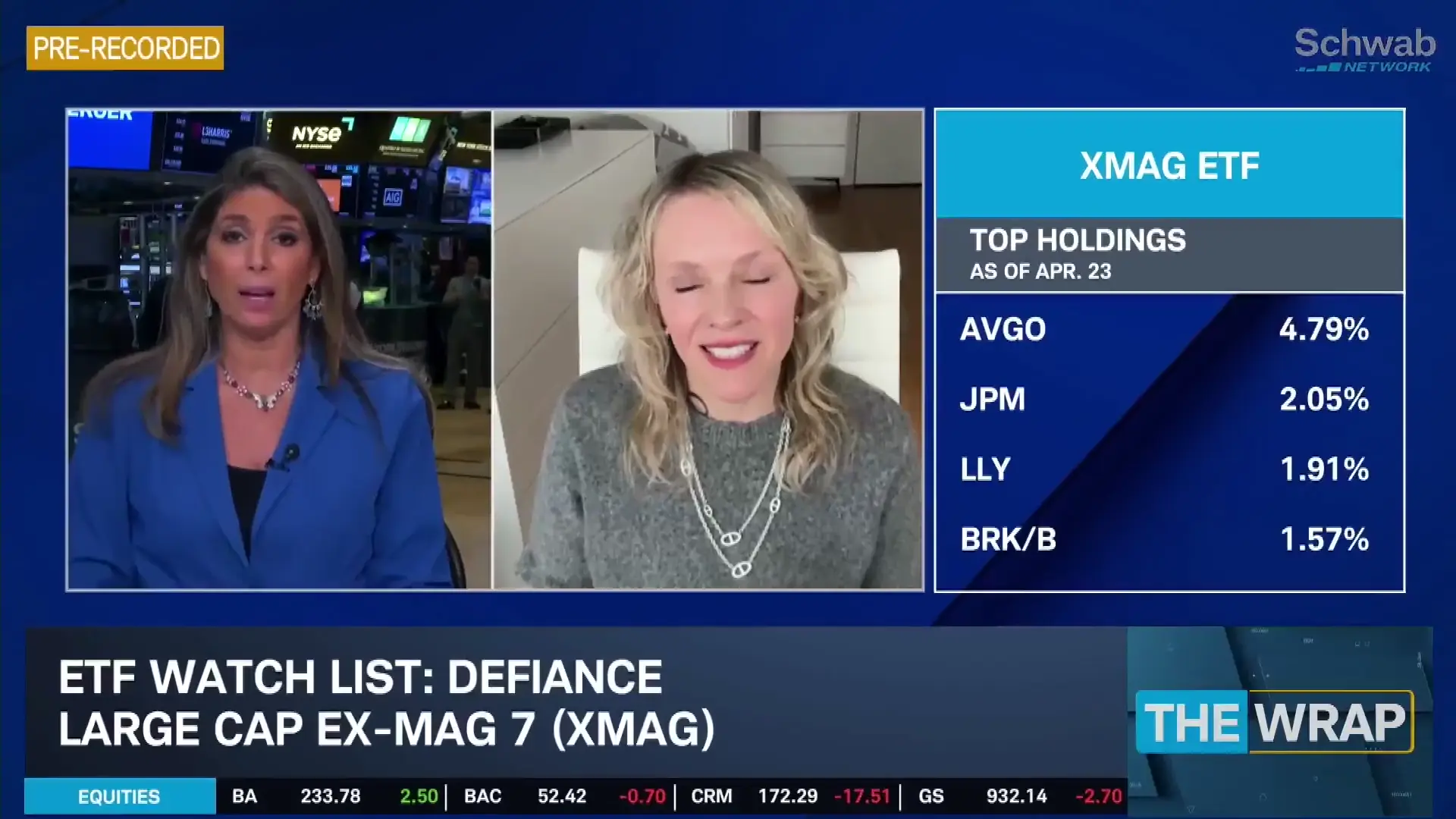
Corporate America is in the midst of an AI spending spree, with analysts estimating total infrastructure investments could exceed $650 billion by 2028. Sylvia Jablonski, chief investment officer at Defiance ETFs, noted that ‘the Mag 7 stocks are now trading at a 30% premium to their historical valuations, but the market is pricing in a decade of AI-driven growth.’
[CLIP: Market Drivers and Earnings Season Analysis - 2:58]
The spending surge is not limited to tech giants. Traditional industries like manufacturing and healthcare are also investing heavily in AI, with companies like Siemens and Johnson & Johnson announcing multi-billion-dollar AI initiatives. ‘This is not a bubble; it’s a structural shift in how businesses operate,’ argued Lizanne Saunders, Barron’s AI correspondent.
Cannabis reclassification: A green rush for pot stocks
The Trump administration’s decision to reclassify cannabis from Schedule 1 to Schedule 3 has sent pot stocks soaring. Chris Clark, PhD, Washington State University’s cannabis policy expert, called the move ‘a watershed moment for the industry.’
[CLIP: Cannabis Policy Shift and Market Reaction - 1:00]
The reclassification allows cannabis companies to deduct ordinary business expenses, a change that could add billions to their bottom lines. Tilray, one of the sector’s bellwethers, saw its stock surge 22% on the news, with Bernstein raising its price target to $35. ‘This is the beginning of the end for prohibition-era stigma,’ Clark noted.
Geopolitical risks and market resilience
Despite the turmoil in the Persian Gulf, analysts are cautiously optimistic about the market’s ability to absorb shocks. ‘The U.S. economy has shown remarkable resilience, with jobless claims rising only modestly and consumer sentiment holding steady,’ noted Fed watcher Kevin Hanks. However, he warned that ‘the Iran blockade could trigger a supply shock if it disrupts oil flows through the Strait of Hormuz.’
[CLIP: Labor Market and Inflation Data Analysis - 2:40]
The Federal Reserve’s latest data shows jobless claims ticking up to 214,000, slightly above expectations, but still indicative of a stable labor market. Inflation data, however, remains sticky, with the Iran war pushing energy prices higher. ‘The Fed is walking a tightrope between growth and inflation,’ Hanks concluded.
Press Monitor Clips:
Tesla Earnings Deep Dive: AI Transition and Market Reaction;
Bitcoin and Crypto Market Analysis: Recent Rally and Pause;
Cannabis Policy Shift and Market Reaction
ameritrade's Best Sports Coverage: Schwab Coaching and Investing Education
Schwab Network’s community-driven investing education
In a market landscape dominated by volatility and uncertainty, Schwab Network is doubling down on its commitment to financial education with the launch of Schwab Coaching. Jenny Horne, the network’s lead host, emphasized the platform’s ‘community-driven approach to investing.’
[CLIP: Schwab Network: Schwab Coaching - 0:57]
The initiative features live audience interactions, expert-led workshops, and a focus on ‘investing smarter’—a tagline that resonates in an era of AI-driven market disruptions. ‘Our goal is to democratize investing education, making it accessible to everyone, not just Wall Street elites,’ Horne stated.
The segment also highlighted the role of social media in financial education, with Schwab leveraging platforms like X (Twitter) and LinkedIn to reach younger investors. ‘The next generation of investors is digital-native, and we’re meeting them where they are,’ Horne added.
ameritrade's Best in Other Coverage: Personal Stories and Technical Analysis
Personal financial journeys: Lessons from adversity
In a heartfelt interview, financial consultant Jim shared his personal story of overcoming a stroke and how it reshaped his approach to investing. ‘The stroke taught me that financial security isn’t just about returns; it’s about resilience,’ he reflected.
[CLIP: Personal Financial Story Segment - 2:31]
The segment underscored the importance of financial planning and consulting with experts, a message that resonated with viewers. ‘Jim’s story is a reminder that investing is as much about life as it is about money,’ noted one viewer in the live chat.
Technical analysis: Reading the market’s tea leaves
Rick Ducat and Tim Bigham delivered a masterclass in technical analysis, dissecting the price action of Avis Budget Group (CAR) following its earnings beat. The stock’s explosive rally—up 40% in a single session—was attributed to a ‘perfect storm of short covering, volume spikes, and RSI momentum,’ Ducat explained.
[CLIP: Avis Budget Group Short Squeeze Discussion - 0:09]
The duo also analyzed Micron Technology’s breakout above $450, arguing that the stock is ‘undervalued by at least 20%’ based on forward earnings multiples. ‘The AI super cycle is just getting started, and Micron is a prime beneficiary,’ Bigham noted.
Options trading strategies: Managing risk in volatile markets
Jenny Horne and Nicole Pedalides walked viewers through a sophisticated options trading strategy, focusing on a short put vertical spread targeting a stock around the $70 level. The strategy, which limits upside but caps downside risk, was framed as ‘a way to generate income in a choppy market.’
[CLIP: Options Trading Strategy Discussion: Vertical Spreads and Risk Management - 6:14]
The segment also highlighted the role of implied volatility in options pricing, with Horne noting that ‘volatility is the market’s way of pricing in uncertainty—and right now, uncertainty is at an all-time high.’
Reddit’s advertising potential: Trust and authenticity
Megan Brantley, Reddit’s head of advertising, argued that the platform’s ‘human-driven content’ gives it a unique advantage in the social media landscape. ‘Users trust Reddit because it’s not algorithmically curated; it’s community-driven,’ she stated.
[CLIP: Reddit Advertising Potential: Trust and User Engagement - 4:35]
The segment also featured a live Q&A with Reddit users, who praised the platform’s authenticity compared to competitors like Facebook and Instagram. ‘On Reddit, ads feel like recommendations from a friend, not an algorithm,’ one user noted.
Press Monitor Clips:
Personal Financial Story Segment;
Avis Budget Group Short Squeeze Discussion;
Reddit Advertising Potential: Trust and User Engagement
Looking Ahead:
The coming weeks will be critical for investors as geopolitical tensions, AI spending trends, and earnings reports continue to shape market dynamics. Analysts are particularly focused on the following catalysts:
-
The Fed’s next policy meeting (May 7) and its stance on inflation;
-
The outcome of U.S.-Iran diplomatic talks;
-
Tesla’s robo-taxi rollout and its impact on the AI ecosystem;
-
The reclassification of cannabis and its long-term implications for the pot stock sector.
‘This is not a market for the faint of heart,’ warned Joe Mazzola. ‘But for those who can navigate the volatility, the opportunities are unprecedented.’

Industry Solutions