Global Flashpoints, Economic Shifts and Sports Icons: The Day's Must-Watch Newsmax-2 Coverage


The world’s geopolitical faultlines deepened today as the U.S. naval blockade of Iran tightened its grip, sending shockwaves through global energy markets and Middle East diplomacy. Meanwhile, Washington’s political stage saw sharp exchanges over government funding, war powers, and immigration enforcement, while Las Vegas became the epicenter of economic debate as Donald Trump outlined his vision for America’s financial future. In sports, historic legacies collided with modern crises, from Wrigley Field’s storied past to Saudi Arabia’s golf league teetering on the brink of collapse.
Top Political News, Issues and People
The U.S. naval blockade of Iran escalated into a full-blown economic crisis for Tehran, with daily losses estimated at $500 million and 90% of Iran’s economy now dependent on contraband goods smuggled through the Strait of Hormuz. Admiral Cooper, speaking in a panel discussion, described Iran’s military and economic infrastructure as ‘devastated,’ while diplomatic pressure from China intensified to resolve the conflict. The blockade’s ripple effects are being felt globally, with Iran’s oil exports to China—once 55% of its imports—now severely curtailed, and the country struggling to pay salaries or fund basic services like food and medicine.
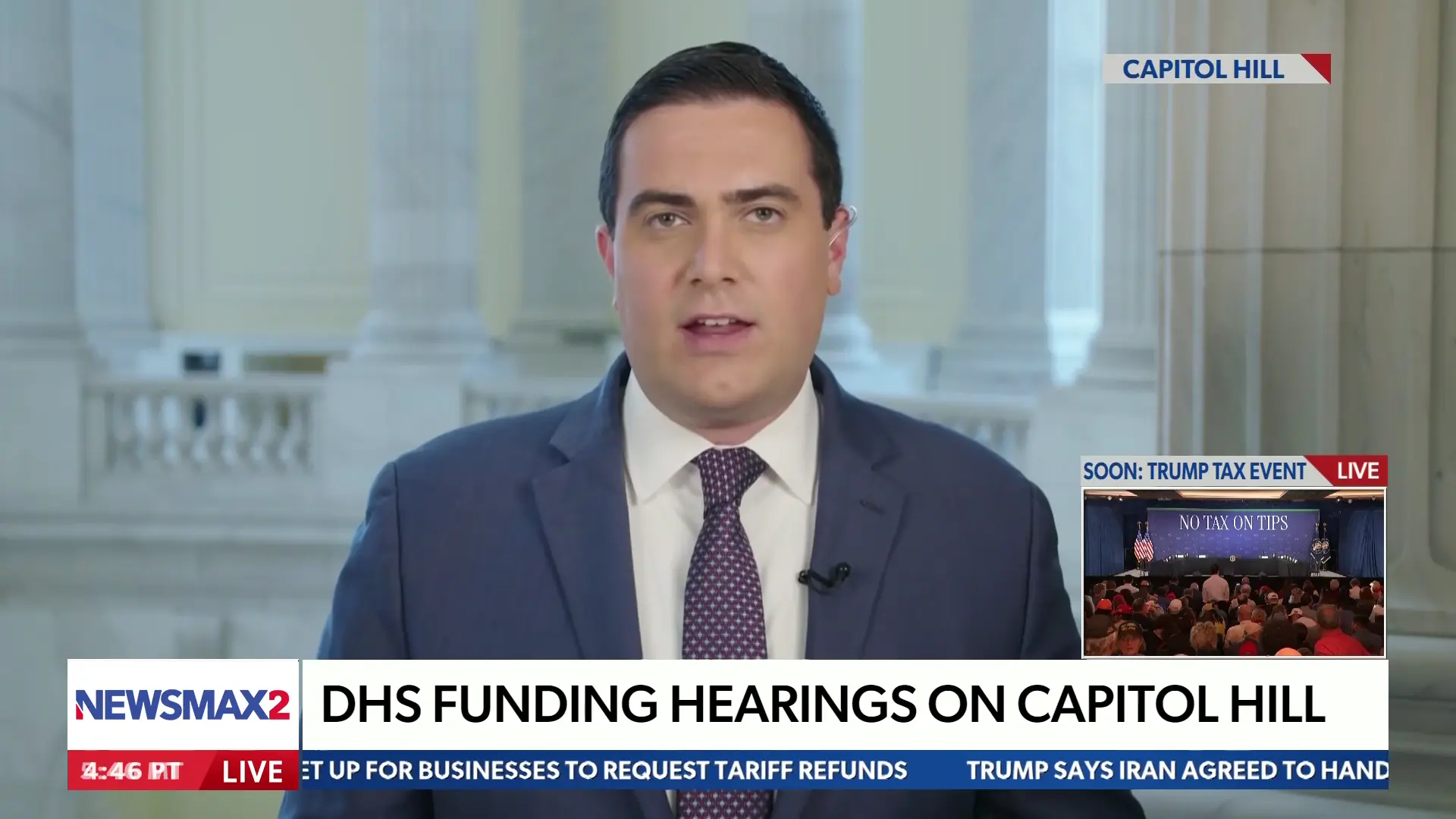
Congresswoman Sherry Biggs took center stage in an exclusive interview, linking the partial government shutdown to ICE funding battles and the recent war powers resolution vote. Biggs, a Republican from Capitol Hill, framed the standoff as a test of congressional resolve against President Trump’s Iran policy, warning that further delays in funding could embolden adversaries. Her remarks came as the Department of Homeland Security faces mounting pressure to balance enforcement with humanitarian concerns, particularly along the southern border.
The Middle East ceasefire, brokered under intense U.S. mediation, remains fragile as Hezbollah’s influence in Lebanon grows. A breaking update segment highlighted the delicate balance between Israeli demands for security guarantees and Lebanese political factions’ resistance to disarmament. President Trump’s sudden arrival in Las Vegas—amid speculation of behind-the-scenes negotiations—added a layer of unpredictability to the diplomatic tableau. Analysts noted that Trump’s presence in Nevada, a state critical to his political base, may signal a broader strategy to tie Middle East stability to domestic economic messaging.
Press Monitor Clips: "Middle East Ceasefire and Hezbollah Analysis"; "Congresswoman Sherry Biggs on Government Shutdown and War Powers"; "Live Updates on Presidential Event in Las Vegas"
Top Business News, Issues and People
Donald Trump’s economic roundtable in Las Vegas crystallized the 2026 election’s defining economic divide: tax cuts vs. inflation relief. Speaking to hospitality workers and small business owners, Trump championed his ‘big beautiful bill,’ which includes a controversial ‘no tax on tips’ policy aimed at boosting take-home pay in service industries. The event, which ran nearly six minutes over schedule, featured testimonials from Nevada business owners like Scott Bessent and Tommy Tuberville, who argued the cuts would spur hiring and investment. Critics, however, warned of ballooning deficits and uneven benefits, with April Becker of the Nevada Restaurant Association questioning whether the policy would trickle down to line workers.
The energy sector’s tectonic shifts took center stage as former Texas Governor Rick Perry delivered a blistering critique of the Biden administration’s European Green New Deal, calling it ‘costly’ and ‘ineffective’ in an exclusive interview. Perry, a longtime advocate of ‘drill baby drill’ policies, highlighted the U.S. record oil exports—now at 12.7 million barrels per day—as proof of America’s energy dominance. His warnings about Europe’s vulnerability to Middle East supply disruptions, particularly from Iran, underscored the geopolitical stakes of U.S. energy independence. Perry’s analysis comes as the U.S. Navy’s blockade of Iranian ports tightens, with analysts predicting a ‘domino effect’ on global oil prices.
Iran’s economic collapse, driven by the U.S. blockade, has reached catastrophic levels, with daily losses of $500 million crippling its ability to fund basic services. The panel discussion on Iran-China trade revealed that Tehran’s once-lucrative oil exports to Beijing have plummeted, leaving the country reliant on smuggled contraband goods. The strain is forcing Iran to redirect funds from its military and security forces, raising alarms about potential internal unrest. Meanwhile, China’s diplomatic pressure on Iran to negotiate a ceasefire reflects Beijing’s growing unease over the blockade’s impact on its own energy security.
Press Monitor Clips: "Donald Trump Economic Roundtable in Las Vegas"; "Energy Policy Interview with Rick Perry"; "Iran's Economic Collapse Analysis"
Top Sports News, Issues and People
Wrigley Field’s 108-year curse loomed large as a segment celebrated the historic venue’s role in baseball lore, from Babe Ruth’s legendary 1908 World Series appearance to Ernie Banks’ enduring legacy. The segment, rich with archival footage and fan testimonials, underscored how Wrigley’s ivy-covered walls have become a symbol of Chicago’s resilience. Analysts noted that the field’s cultural significance extends beyond sports, serving as a touchstone for Midwestern identity and community pride.
The 1980 Winter Olympics’ ‘Miracle on Ice’ reclaimed its place in history as a panel dissected the USA’s underdog victory over the Soviet Union in Lake Placid. The segment, featuring interviews with Herb Brooks’ contemporaries, highlighted the psychological warfare tactics that turned a David-and-Goliath matchup into a gold-medal moment. The discussion also explored how the game’s legacy continues to inspire Olympic underdog stories, from the U.S. women’s soccer team in 1999 to the 2002 Salt Lake City Games.
Saudi Arabia’s golf league crisis deepened as reports surfaced that the Public Investment Fund (PIF) may withdraw its financial backing, leaving the Live Golf League on the brink of collapse. The field report, based on insider accounts, revealed that Saudi Arabia’s economic pressures—exacerbated by the U.S. blockade of Iran—are forcing Riyadh to prioritize domestic spending over sports investments. The league’s struggles have sent shockwaves through the golf world, with players and sponsors scrambling to secure alternative funding.
New Jersey Transit’s proposed fare hikes for the 2026 FIFA World Cup sparked outrage among commuters and politicians alike. An exclusive investigation by Newsmax revealed that the $10 surcharge per match could disproportionately burden low-income fans, with Senator Chuck Schumer leading calls for a federal review. The controversy has exposed tensions between FIFA’s commercial ambitions and local transit authorities’ fiscal constraints, raising questions about who ultimately bears the cost of mega-events.
Press Monitor Clips: "Wrigley Field Historical Highlights"; "FIFA World Cup Transportation Controversy"; "Saudi Arabia Golf League Crisis"
Other Top News, Issues and People
The future of space exploration took a dramatic turn as Professor Avi Loeb, Harvard’s outspoken astrophysicist, outlined a vision for public-private partnerships to accelerate AI and satellite communications. In an interview with John Bachman, Loeb argued that NASA’s traditional model is ‘outdated,’ advocating for a Bell Labs-style approach where government and corporations collaborate on breakthrough technologies. His comments came as Amazon and Globalstar finalize plans to expand satellite networks, potentially revolutionizing global connectivity.
A bombshell investigation into the disappearances of scientists and military personnel with classified nuclear and aerospace backgrounds has reignited espionage theories. Retired Air Force General William McCasland, speaking exclusively, revealed that at least 12 individuals with ties to NASA, MIT, and defense contractors have vanished under mysterious circumstances over the past decade. The probe, which includes links to Harvard’s Avi Loeb and the Astor family’s historic ties to aerospace, suggests a possible ‘clean-up operation’ to silence whistleblowers or obscure sensitive research.
NASA’s 2027 budget proposal, featuring a 47% cut to science funding, has drawn sharp criticism from space advocates. Jared Isaacman, the billionaire entrepreneur and former NASA advisor, warned in an interview that the reductions could derail missions to Mars and delay breakthroughs in AI-driven space exploration. Isaacman’s remarks echoed concerns from the White House, where President Trump has signaled support for commercial space ventures but faces pushback from congressional budget hawks.
The political firestorm over ICE enforcement reached a boiling point as panelists dissected the fallout from California’s primary and the Democratic Party’s internal divisions. Tom Steyer faced scrutiny over his opposition to federal immigration policies, with critics arguing his stance undermines law enforcement. The discussion, which pivoted to Jasmine Crockett’s controversial legal background, highlighted the GOP’s strategy to frame Democrats as ‘soft on crime’ ahead of November’s elections. Crockett’s own political career came under fire, with hosts questioning her qualifications and ethical record.
Press Monitor Clips: "Space Exploration and Private-Public Partnerships"; "Disappearances of Scientists with Classified Backgrounds"; "Jasmine Crockett's Political Career and Criticisms"

Industry Solutions